Here's another college-bound GK who's over-committed to the front post. Yup, he makes the save, but with his foot for two reasons: he's not set so his weight isn't balanced right so the kick save is the easiest option, and, two, he's gone too far past the shooter's line, so instead of scooping up an easy save with his hands, he kick saves, and risks rebounds as well as being on his backside in a difficult position to recover from.
It's good athleticism that gets him so far across the goal, and he does well to keep the rebound very small so he can gather it, but while the spectators all think it's awesome, we can certainly ask for cleaner and better from this guy. He's got tons of tools, but the most important one is the brain; read the angle at which the attacker is running (not toward goal!); know where he's located inside the six and the resulting portion of the goal covered; know where shooters want to shoot; preserve his athleticism for as long as possible and maximize his ability to make a technical play versus an athletic one.
The fear of the near...near post, that is. This column shows a youth level GK, who is solidly college-bound, offerering exhibit "A" regarding conventional wisdom in goalkeeping. Below, in this post we will look at the first goal scored by Messi in the first leg game against Bayern in the Champion's League semi-final.
Here's the youth player:
Is this a great save, or did his positioning offer a higher quality chance than the play should have warranted?
As a recruiter, I love the save, of course. But it does go for a corner (set pieces account for 30-40% of goals, depending on the team and level) and only temporarily stays the danger. Better than nothing, and very good athleticism,
But here's the thing, at the moment of contact, look where the GK has positioned himself:
For a ball this wide, is it reasonable to think the near post is the main concern? Looking, too, at the shape of the attacker's body and this doesn't look like a shooting situation. The GK is nearly on the goal line, but so too is the crosser; the GK should take a more aggressive position perhaps three or four yards off the goal line, and toward the back of the first third of the goal:
Perhaps, with the nearly 1.5 seconds it takes for the crosser to swing this ball in, the GK, had he started at the blue dot could have come to catch (gold standard) or box (better than a corner, usually), or at the very least, been at such an angle to catch the shot rather than going all the way across the goal to tip it out for a corner as he did. Recall Ter Stegen against Man City earlier this Champion's League season.
Nitpicking? Probably...but it's in these mere few feet that games can be won and lost.
Neuer took a beating for the front post goal by Messi, but consider these points:
Messi was on his left foot, so the far post shot is likely
Boateng had the front stick covered, or should have done
There's no way even Neuer can cover the far post against Messi at this range unless he cheats off the near post, &
The pace and shape of the shot made even that very small space difficult to defend.
Ever try to set up for the far post, the way Messi does, and try to yank the ball to the near post? That ain't easy....
The German side played the odds, and with a slight mistake by Boateng and Messi's brilliance and shee courage, something came of nothing.
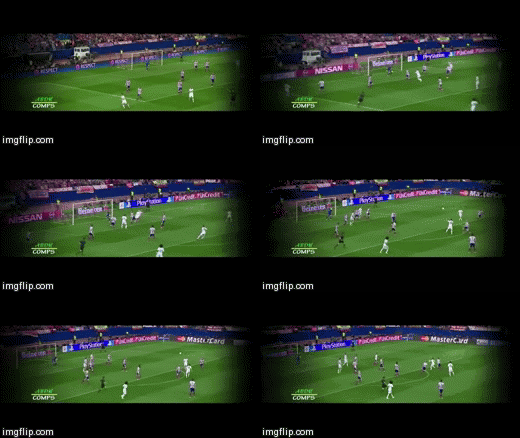
Here's the GIF of Messi's first goal in that fateful first leg:
See that little move Neuer makes, just as Messi loads up to shoot? He's prepared for the far post shot, and he's banking on Boateng covering the front stick, but Boateng turns his back and lets the shot go past him. Add to that whiff the nasty, dipping movement on the shot, and it's a cocktail for a GK disaster. Any shot that takes that short hop directly in front of the keeper offers a nearly un-catchable ball, and the bounce is very difficult to judge accurately.
The folks at Statsbomb did this seminal piece on near versus far post shooting....and if you buy the argument, and that data make it awfully hard not to, Neuer was wisely playing the odds, and nearly got away with it. In this screen grab at the end of the play, we can see that Neuer had stayed close enough to cover the post, he's obviously "there," it's just that the shot was powerful enough to squeeze by him. 9 out of 10 he saves the shot at that location....but that's why Messi is Messi...he's the 1 in 10 genius:
We'll look here at a terrific young GK who plays for a USSF Development Academy team. While I'll critique his positioning here, in full disclosure, I'll offer that my experience tells me that any college level coach will fix this sort of thing in even the most skilled of recruits, and that this kid is a huge prospect. Normal developmental criticism here.
In the GIF below, we see the ball played from the corner of the 18 diagonally forward toward the corner flag. Because the ball is played outside the width of the 18, and well below the penalty spot (ie: less than 12 yards from the goal line) there is very little chance of a shot at goal being taken, and if one were taken, infinitesimally small odds of it beating a GK:
So the issue clearly is that the GK is very tight to the near stick, and when the cross comes in, he can barely put a finger to the ball. No harm comes immediately, but the next level will see a better ball played in, and better runs from the target players to get on the cross. The conservative starting position, most importantly, costs the team a corner kick, and a dangerous set-piece situation (30-40% of all goals come from set peices!) So what could be an easy catch and a chance to counter attack (we can see at least 4 dark shirts inside the 18 so 6 still back covering, but there may be a counter on with good distribution) has now become additional danger.
It's thinking too small to say that the danger was avoided, even if temporarily, when a more aggressive starting position could have turned the tables completely and created another cause of sleepless nights for coaches, a counter attack. Little moments like this make and break careers, seasons, and separate the best from the rest. The good news is that for this particular player, if he can work with good coaching, and take criticism, study his job and put in the time and focus on the training ground, he can easily make this play into something advantageous for his squad.
By way of contrast, here are two pretty good GKs, Keylor Navas and Fernando Muslera in similar situations...for my preferences, I like Meusler's approach a bit better:
A hot topic in the circles I'm running in these days is the movement of the front players when they're off the ball...how to get players to be more dynamic (and yet not frenetic/chaotic) and purposeful when breaking the final line of defense is starting to feel like the holy grail. Or shopping for unicorns.
Here's a couple GIFs of good movement...very likely the first installment of a series, as these are merely two examples of a great many patterns of movement players may choose from.
MLS haters are fighting a losing battle. The wide player attacks toward the center as two teammates surge forward, cross their runs, then recover back to remain onside, and execute very tidy combination play to create the goal. Great stuff.
If you're talking off-the-ball-movement, you have to talk Barcelona. This is Guardiola-era stuff, but wow...
Wide player is patient, stays wide, receives the ball and attacks centrally, the forwards watch closely, and when the teammate with the ball is facing goal with a bit of room to work, they surge forward and cross their runs, execute an unselfish pass inside 8 yards from goal and score. The flowing nature of this movement, even with the players who don't touch the ball, is wondrous to watch:
The full video of this GIF is at the bottom...4 minutes of top-class analysis:
In investigating the shooting percentages of NCAA Division III men's soccer, the curious relationship between the 10 power conferences and their shooting stats was uncovered. In a nutshell, the strongest conferences miss the target more often and score just about the same number of goals than the less-competitive leagues ("strongest" and "less-competitive" are highly debateable terms, but with all due respect to the teams involved, it's a useful shorthand.)
Here's the top ten leagues (it's actually top 9 but I'll update it soonish) with an overall goals-per-game average of 1.72 :
Now, the bottom 10 leagues, overall goal-per-game average of 1.64:
The bottom 10 miss the target somewhat less...they also play a weaker schedule, typically, but you'd also expect that weaker leagues are that because they have less talent, across the board. So, conceivably, the shooting ratios could remain fairly even, but the top teams are skewed somewhat toward missing more. Maybe those "better" players are over-confident and take shots from poor areas. Or, better teams are better organized (better coaching?? That's hugely debateable) and so the raw offensive talent has a harder time breaking down better organized teams. At any rate, I half expected to see the top leagues hit the target with noticeably greater accuracy.
So I'm somewhat confounded...
But, using the wonderful database at whoscored.com, where the data are recorded with more precision and reliability, I found the EPL offered some help. Most DIII soccer matches have student statisticians who may or may not have a discerning eye when deciding if a ball headed toward goal was intended as a shot or not (among many other statistical gray areas). For the EPL, I found this over two seasons:
This chart shows the Shots Not On Target as a percentage of all shots (X axis) and the per-game-average number of goals scored (Y axis) for the 17 teams to play in both the 2012-13 and 2013-14 seasons:
The EPL looked just as lousy as the top 10 conferences in terms of percent of shots not on target!... but something on whoscored.com caught my eye. They track blocked shots...something the NCAA doesn't require. When including blocked attempts, if we assume that all blocked shots would have been on target, the EPL squads suddenly look very different (both EPL charts are scaled to the same parameters, so while the dots are clumped, it emphasizes the huge factor blocked shots play). Here's the proof:
So...NCAA teams miss the target way too much if we factor blocks into the comparison. Of course, NCAA statisticians don't factor blocks, so perhaps things would look better if they did. What do we learn from all this? One, better teams are somehow more wasteful than less competitive teams...this needs much more research. Two, blocking shots has a massive impact on your opponent's efficacy in front of goal...do NCAA defenders do nearly enough of this? My gut tells me, though I have no data, that NCAA teams block shots far less often than the EPL players. Which is crazy, because of all the skills required to play soccer well, standing in front of a guy kicking a ball isn't nearly the toughest to develop.