Wednesday, April 24, 2013

Coventry/HMMS Recaps

A couple solid wins see us heading to the state semi-final this weekend.  Two goals against in 180 minutes of 8v8 soccer isn't too bad.  10 goals in three games is a good scoring clip as well.  A few thoughts, and some themes that we've been working on all year which got highlighted came up the past two games:

The Coventry Goal

A turnover in our half, a lack of ball pressure following the loss of possession, an excellent pass across the width of the field where our midfielder was too close to the wide attacker, allowing the ball over his head and into the space behind; that space was too big for the GK to cover - the ball wouldn't have gone deep enough into the 18 anyway - and it became a simple footrace which Cole lost.  The finish was very good, leaving Henry little chance of saving.

A good goal for Coventry...they worked the situation nicely.  But the turnover, lack of transition speed of thought to defend, the very slight mis-positioning of Cole, and the boys could see how important these details can be.

Thursday, April 11, 2013

Quick Boys

FC Providence Recap

Hopefully no one from HMMS or Coventry will read this...

In the FC Providence match, our lineup seemed to cause some problems for the FC Providence defense.  However, whatever the source of the difficulty, the QBoys weren't quite attuned enough to fully take advantage.  Hardly a surprise; 12 year olds have a hard time seeing patterns across whole teams (it's why we play 8v8 at this age group-it's why we coach more technical stuff than tactical, or should be).  But I mentioned it in the team email after the game, and it raises some points that are germane to the understanding of a developmental model of coaching versus other approaches which put winning ahead of other goals.

Here's the general layout....QB's in red, attacking toward the bottom of the picture.  The ball, as a fer-instance is with our right midfielder (Marc, Wyatt, mainly):

Wednesday, April 3, 2013

College Selection

Food For Thought

A couple weeks ago, Haverford College Men's Soccer held a "Junior Day" for high school juniors who had been identified as high-interest prospective players for our program.  The boys and their families spent the day hearing from Admission, the coaches and players, touring campus and generally getting a nice feel for the college.  Three points jumped out from that morning's events:


  1. Of the 10 men who spoke to the recruits, all of them found their way to Haverford via camps- not one mentioned getting recruited via a tournament.
  2. Of the class of 2016, 6 of 7 applied early decision (the eighth first year student was a walk-on, un-recruited with no help from the soccer office in the admission process).  The 6 ED applicants represented a 60% success rate (no one who was accepted ED declined to attend Haverford).  Haverford reported an overall admission rate in 2012 of, drumroll please: 22.9%.
  3. Of the high school students in the room, every boy had contacted Haverford first.  3(a): Haverford, like most Division III schools has a recruiting budget of a couple thousand dollars.  As a gentle reminder, from a previous post on the odds of making it to the college level as a soccer player:
There are, roughly, 4 million soccer players registered with the USSF-affiliated programs in this nation.  Divide that number by 13 (ages 5 through 18) and we have 307,000 players per year/age group, or 153,500 per gender.  Those high school seniors who play the game are competing for spots on 598 teams (men's division I & III) and 735 (women's division I & III).  The netherworlds of NCAA division II and NAIA soccer are less-traditional higher education options- comprehensive colleges, small state schools, religiously affiliated, etc. - and virtually none of the top liberal arts or research universities fall into these two categories.  Presuming that most players would rather go to Williams or Stanford than Hastings College or Lindsey Wilson College (2011 NAIA Men's Finalists...) we'll work with those numbers alone. 
That leaves us 255 players per year, per NCAA (DI & DIII) team graduating from high school. Over four years, each of the DI & DIII teams have a pool of about 1,000 players to pick from.

If this space offers nothing else, let it be the perspective of what a massive accomplishment it is to play college soccer.  Period.  But let it also be, just a little bit, a source of reminding anyone who loves the game to ask occasionally why they are involved, and what they hope to gain from that involvement. 

Tuesday, March 12, 2013

Women's Pro News

Former Colgate Player Brought To Western New York Flash

A player from Colgate University women's soccer has been called upon to join the Western NY Flash for the preseason.  Ashley Walsh was a four-year starter at Colgate, earning numerous accolades in her time there, including two Patriot League championships and the ensuing NCAA tournament appearances (2009 & 2012).
WSOC
A Colgate legend
Having coached Ms. Walsh for three of her four years, there is a long list of superlatives I could offer on her behalf.  Perhaps most telling, however, is the simple fact that one winter the men's team at Colgate was short GKs and Walsh trained occasionally with the men, and more than held her own.  Given that the men sent three guys to the MLS (though none were able to make a roster at the end of the day) it's not like Ashley was keeping up with average players.  She was more than talented and determined enough to be well-respected by the men's team and their staff.  The WNY Flash will be closely watched in this space to see how this former Colgate stand out fares.

Lastly, it is even more important to note that Ashley is not just talented, but she's also been a highly successful student at Colgate and is a genuine, kind and personable woman.  No ego here, she is the consummate teammate, and I cannot imagine that anyone who has played or worked with Ashley will wish anything but the greatest success for her on this new endeavor.

Follow the fledgling NWSL here and check this space for updates, too!


Monday, March 11, 2013

Letter to the USSF

The USSF's Perspective Problem

Well-Intentioned Soccer Insiders Must Remember 
The Love Of The Game

As I take in more and more of the soccer landscape in America, meeting new coaches, talking with more parents and players, observing match after match at parks and indoor facilities, a couple things have begun to bubble to the surface that seem worth sharing- hey, I have my little soapbox here, might as well shout from it.

There are a lot of reasons to coach (I outlined a few of mine here when I moved to Philly) but the overarching source of satisfaction is seeing how completely a player under my care can reach his or her potential.  Sadly, I haven't been able to stay in one place long enough to watch a kid through the entire youth career, but in five years with OSSC in NY, I worked with every age group in a small enough organization that I was able to closely observe a lot of kids as they grew over those five years.  I also keep getting reports even now from colleagues and families with whom I keep in touch.  It's the little game I'm playing in my head -if you ever see me on the sideline looking a little distant, it's a fair bet I'm comparing and contrasting someone's performance over time - day in and day out.  But it occurred to me the other night as I stood out in the rain at Tee's with three players at training that my objectives may not be anywhere near to the goals of the families involved.

Thursday, March 7, 2013

German Cup

Bayern Build From The Back Line

From the German Cup match versus Dortmund, we see Bayern build patiently from a throw-in, but when the defense gets stretched out, the attack to goal is instant, if not as accurate as Bayern would have liked.  Whether this is good, thoughtful attacking or broken team defending is debateable - without hearing from the manager what was sought for either team in this situation it can be tough to make conclusive analyses.  Maybe the two Dortmund players thought they could trap Dante, and just missed it...but Dante is pretty technical, and could always bail himself out by playing backward to Neuer.  Leaving Schweinsteiger seems ill-advised; perhaps there was a miscommunication as to who was to pressure Dante.

At any rate, the pics show a really nice instance of patience in build-up play, the effective creation of a 2v.1 and then good, calm breaking of high pressure (easier than it could have been as there was no defensive support for the two forward Dortmund players when they attacked Dante) and then a fast attack to take advantage of numerical superiority on the left side of Bayern's attack.
Bayern throw the ball in.  Dante, the left center back receives and initiates the attack.

Monday, March 4, 2013

Stopping PKs

Pro (Hart) Versus "joe"

Three PKs, One Stop: 
Simple Geometry The Difference

Joe Hart (forgive the lousy pun in the title...) made a PK stop the other day for Man City.  Sam Miller, a Haverford College recruit (HS class of 2013) saved one of five in a shootout he shared with the college staff.  Sam, to his credit, guessed right on 4 of 5, but dove over the first two shots...the last shot, which he saved, was identical to the first two in all ways (speed of the shot, him guessing correctly, overall evolution of the play, etc.) except that the shooter left the ball maybe 18 or 20 inches higher than the first two shooters...and it hit Sam in the chest.


No kidding, a GK has less time to react (and a lot bigger "strike zone" to cover) than a MLB hitter.  UVA helps prove it here; and the Huffington Post gives us some info here.

So here's a little helpful advice...with the caveat that every player who stands between the sticks and faces a PK must be firm in their own mind, and be fully committed to whatever course of action chosen.  Much like 1v1 moves (they don't all work equally well for all players), attempting to stop a PK is a highly personal moment.


Look at the two freeze-frames, and notice the dramatic difference in launch angles by the GKs:

The ball is at the red dot's location.  Sam, here, shows a line from his toes, through his knee, hip, shoulder that transects the crossbar, about a yard inside the post.  Steep.  Ball snuck under his ribs.
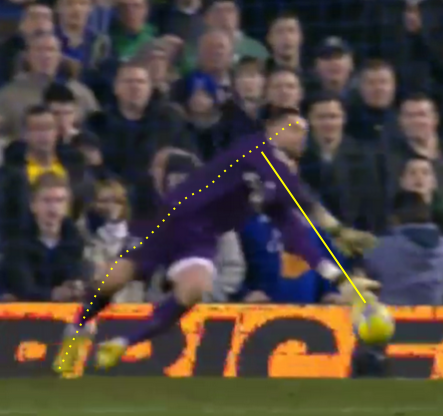
Hart, here with his hand just touching the ball (and the shot coming much faster at him than the shot at Sam) shows a line from his toes, through his knee, hip and shoulder that transects the post, about a yard below the crossbar.  Flat.

At 6' 3" or 4", we can see that Hart's left arm could cover a ball in this instance that is more than halfway up the post...so he's covered more than 25% of the goal.  Shooters know that GKs have a hard time getting low, and that the lower they shoot, the less likely they are to miss the target outright (better to be saved than miss completely).  It's doubtful the founding fathers of football had any idea when they selected the dimensions of the goal back in ye olde dayes, but the physics of the game dictate that max power on a shot requires some lift of the ball; any shot on or near the ground tends to be just a bit slower.  The trade of is the difference in time it takes a GK to get to a ball low in the corner versus a strike three feet high and just inside the post.

One more pro, this fella from Oldham failing to stop a PK (during which he's clearly anticipated correctly):
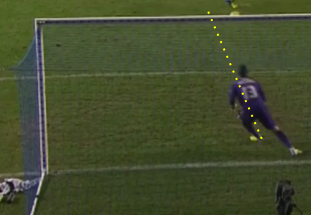
The shooter's foot can just be seen here, just striking the ball.  The GK's body is moving the correct direction
but far too tall; the ball slipped under his hip.
Here's the front view of the moment where he gets his hand on the ball, but it sneaks underneath him.
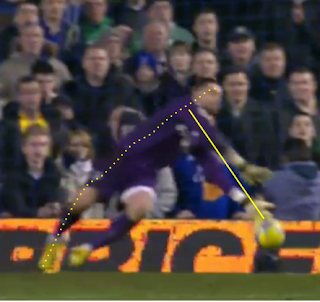
The dotted line is the toe/knee/hip/shoulder line, the solid line is his arms.  It's tough to stop a spot-kick with just the hand and arm; the body must be behind the catch or parry.
Young GKs...learn to dive explosively and low.